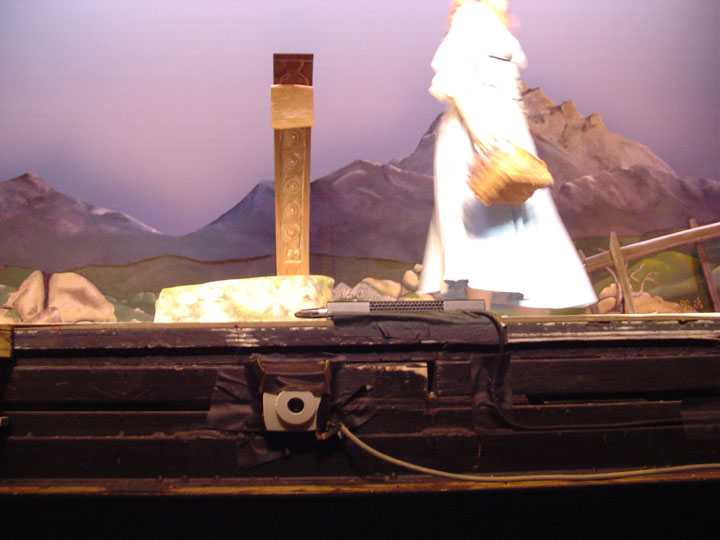
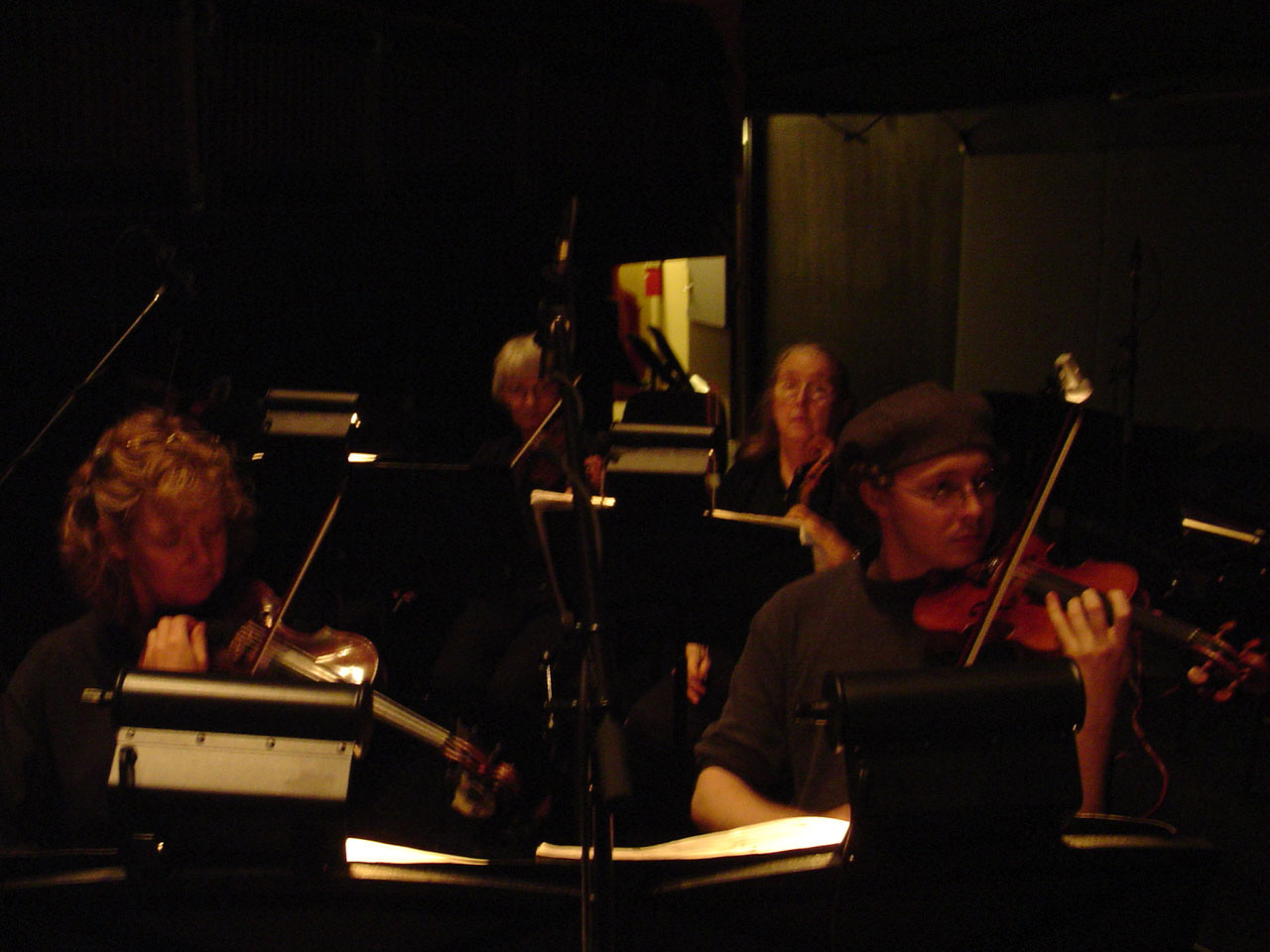
This was my view while conducting Brigadoon at the Kirkland Performance Center in September 2007. Several people asked me for an explanation of the wired contraption you see in the middle of the photo. One child in particular spent most the show trying to figure it out and had some great guesses about it.
The item lying on top of the stage is a stage microphone used to capture overall ambience from the chorus. There are normally three of these across the stage – Left, Center, Right. The sound designers will use these to bring up ambience during large crowd scenes or chorus musical numbers.
The grey item taped in the center with the larger cord extending from it is just a camera. For many scenes in Brigadoon the choir sings from backstage and it was difficult for them to see me for timing. So the sound techs put the remote camera in place and the choir watched me backstage on a monitor. The chorus said the monitor had a little of a fisheye lense effect and made my hands look gigantic, but for keeping time it worked very well.
We had used the same concept during another run of Brigadoon, but the lighting was poor and the chorus couldn’t see me well in the monitor – and boy could I tell from the pit. Timings were not together. You can use a simple computer camera to do this – make sure to check lighting under show conditions so viewers can easily see directions from conductor.
And to the boy who was convinced it was not just a camera – well…..MAYBE it’s actually a launch button I can press to launch a spaceship.
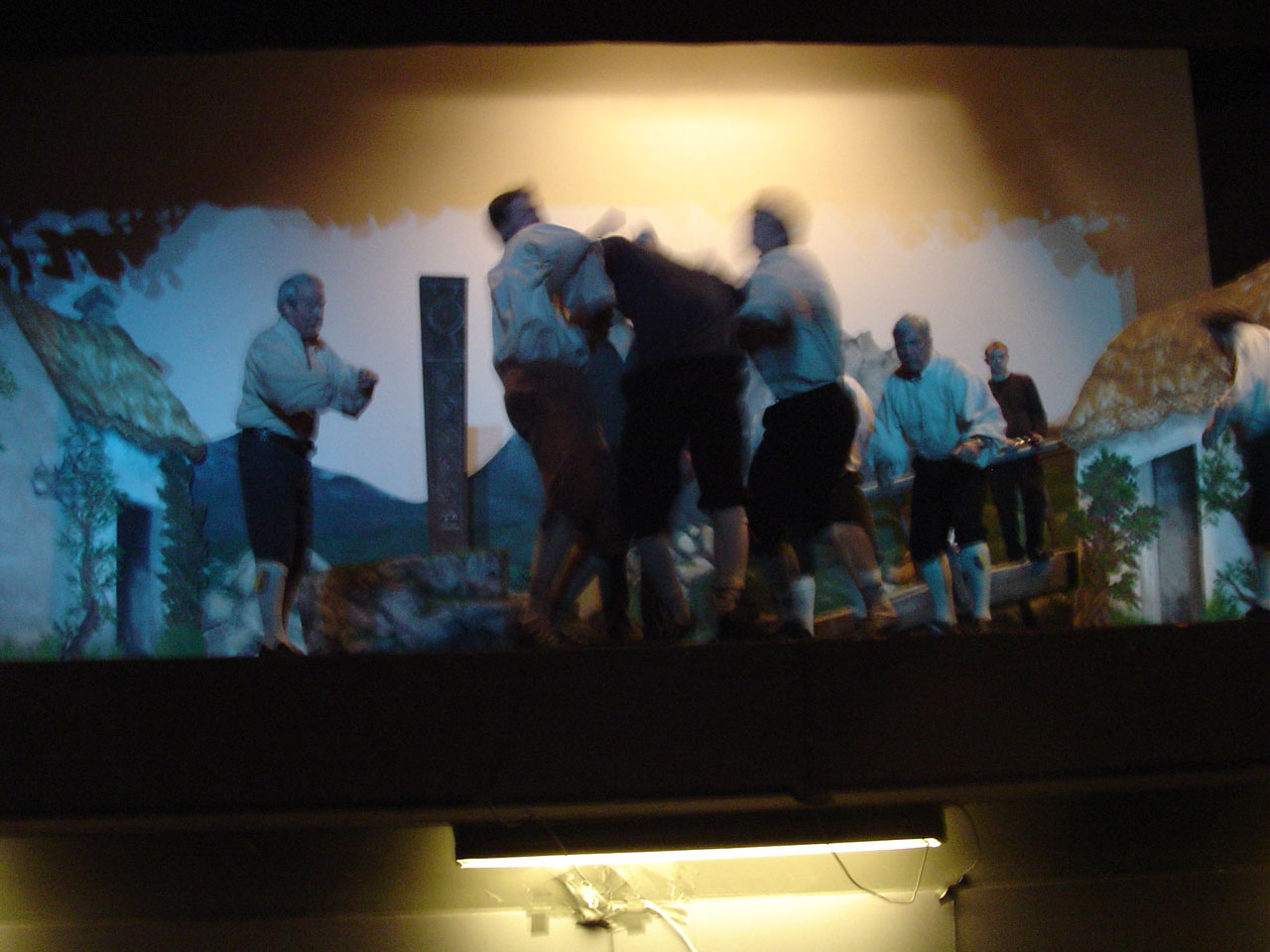
MORE BRIGADOON PHOTOS
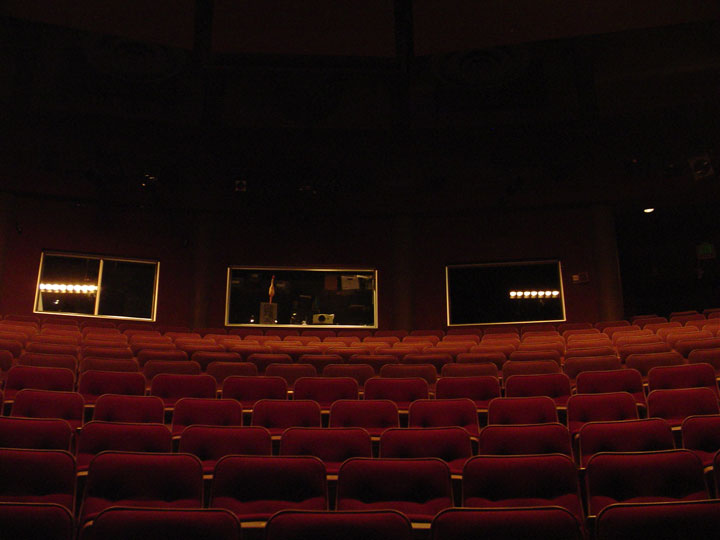
View from Conductor’s podium looking at audience
Kirkland Performance Center, Kirkland, WA.
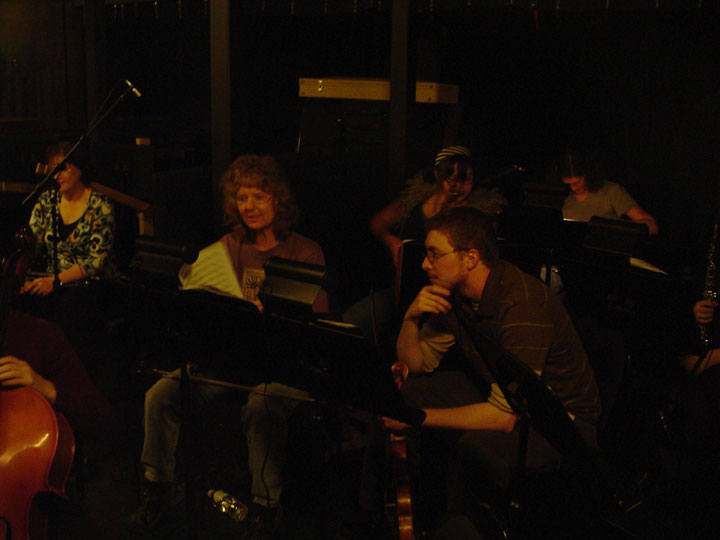
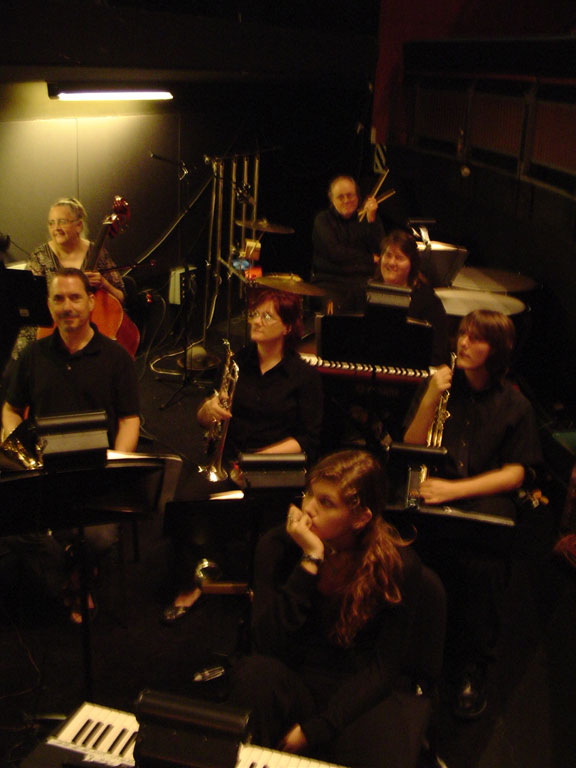
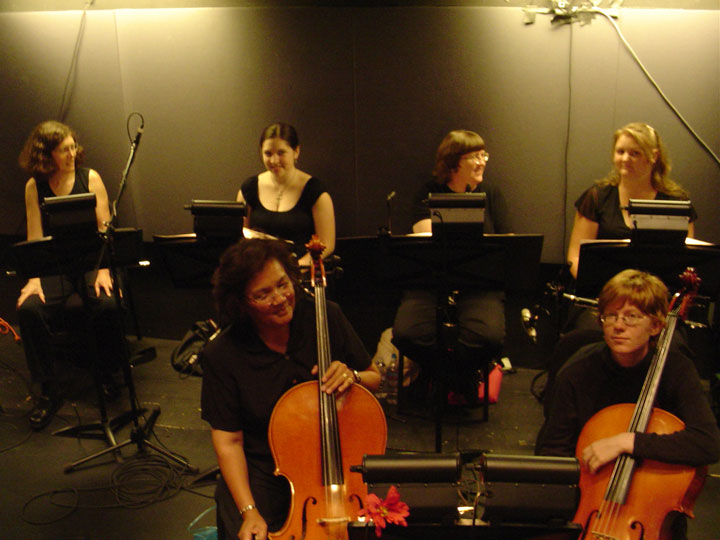
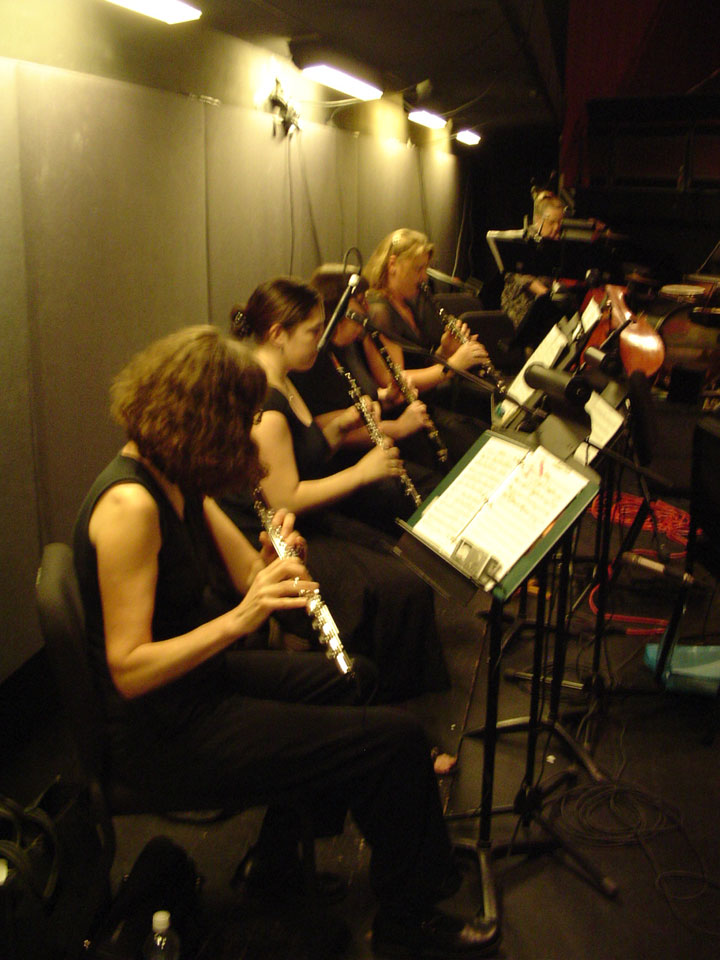
Musicians in the orchestra pit (read Dark Scary Cave of Doom) at Kirkland PAC
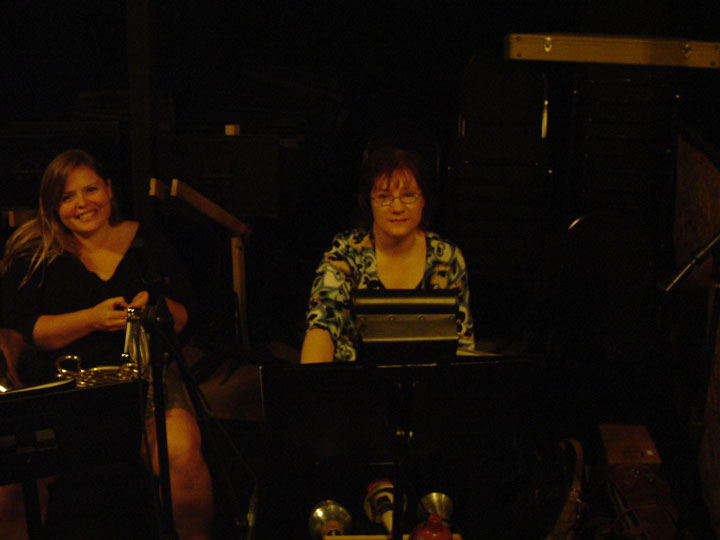
French Horn and Trumpet in Kirkland Orchestra Pit.
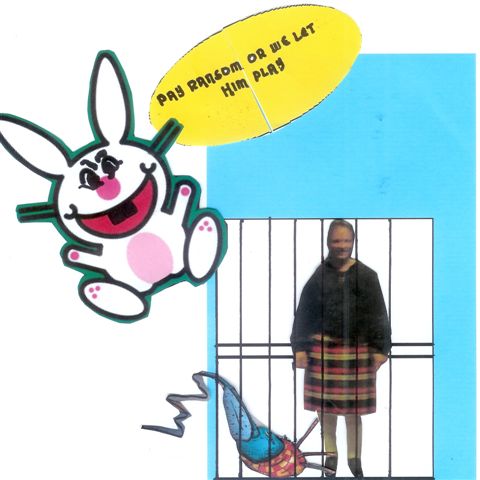
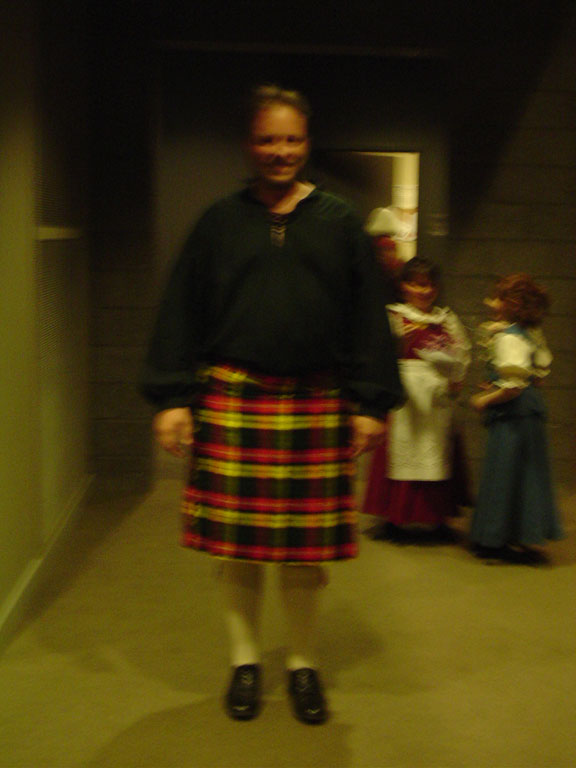
Muahaha! My friend from the Great White North just sent me this. Now you need to realize that I recently posted an entire gallery of Happy Bunny graphics, and also conducted Brigadoon (including bagpiper) wearing a kilt – So this is all that craziness combined. Thank you!
I don’t normally post comments about shows I work on because it seems a bit haughty with me being part of the production team. But Brigadoon 2007 at McIntyre Hall really is a fine production. On the music end, the orchestra is really incredible. Not too far a stone’s toss from a 5th Avenue pit group.
This is one of my last shows in Skagit County before I go back on the road and I hope friends and local theater folk have a chance to see this production. This show does great honor to McIntyre Hall and to local theater folk who put their heart and soul into the arts.
And to the McIntyre family of Skagit – I don’t know you, but your generostiy in creating McIntyre Hall is helping to propel Mount Vernon, WA and surrounding areas into rich fertile soil for up and coming artists.
SOME COMMENTS:
Wonderful! Such a beautiful time we had!
Thoroughly enjoyable;hope you will do more in this great theatre
This was by far the best performance I’ve seen in the area.
This is the kind of show I dreamed McIntyre Hall was built for.
Enjoyed it completely!
Terrific! What a great production for the community!
Magical! I love the story, the dancing, singing, and message.
I really enjoyed combining professional and local talent. Fantastic idea! Keep up the good work!
Very professional–good scenery and acting
Awesome!
Mists of the Highlands Reach Skagit
by Bev Crichfield – Skagit Valley Herald www.GoSkagit.com
 Mount Vernon, WA – Welcome to the Scottish Highlands, where the mists of the moors hide a magical town called Brigadoon, and weary travelers can spend a day enjoying good music, friendship and even find the ever-elusive true love of their lives.
But be careful — it can only happen one day out of a century.
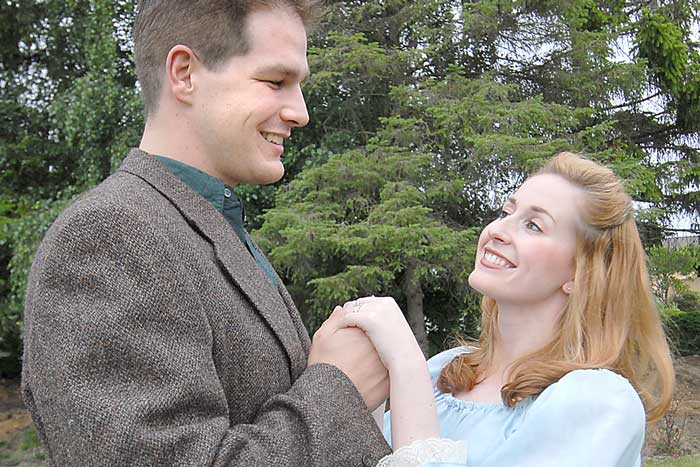
Everything about the Broadway musical “Brigadoon†is enough to make a woman swoon, said Brenda Mueller, director of the Lyric Light Opera’s production of the 1947 Lerner and Loewe classic set for three weekends in July at McIntyre Hall in Mount Vernon.
“You cannot find any more beautiful music from a musical than in ‘Brigadoon,’†Mueller said, while preparing to lead the chorus through a scene last week during rehearsals.
The romantic storyline continues to satisfy the imaginations of audiences years after it was written, Mueller said. “It’s magical. There’s the mists of the Highlands; you enter it and it just sweeps you away.â€
The production is the perfect fit for the Scottish-themed lineup of events throughout July in Skagit Valley, Mueller said. Lyric Light Opera is collaborating with the Skagit Valley Highland Games, set for July 14-15 at Edgewater Park in Mount Vernon.
Part of that collaboration has meant a few professional bagpipers who will compete in the games have offered to add the uniquely Highland sound of their instruments to the 23-member orchestra, which includes violins, woodwinds and a more classical style of music than most Broadway musicals.
Although it’s usually performed as a typical stage musical, Brigadoon has been considered borderline opera, and sometimes is performed by opera companies, Mueller said.
Standing in the hallway of the church where the 45-member cast was rehearsing last week, opera singer Megan Chenovick, who plays the female lead Fiona, said she was excited by the opportunity to do some “classical†singing for her part.
“There’s some great music and so many standards that people are going to recognize,†Chenovick said, including the romantic “Come To Me, Bend To Me,†and “The Love Of My Life.â€
Some of the tunes were so well-written that there isn’t much a singer has to do to make them new and fresh, said Tim Glynn, who plays the young, energetic Charlie.
“ ‘Come To Me, Bend To Me’ makes me feel so not needed,†Glynn said. The emotions that flow out of the lyrics and music are enough by themselves to sway an audience, he said.
Glynn is one of five professional performers hired by Lyric Light Opera for the $100,000 show. Those leads come from Seattle and have performed with such large theater companies as the 5th Avenue in Seattle and the Village Theatre in Everett and Issaquah.
Many cast members in the Stanwood-area based group are from Anacortes, Arlington, Bellevue, Camano Island, Marysville and Mount Vernon.
“Brigadoon†is the second big Lyric Light Opera production since the group was formed in 2006 out of the remnants of the Northwest Civic Light Opera. It’s a larger, more elaborate — and costly — endeavor than the group’s first show last July, “Annie Get Your Gun.â€
And despite the hiring of five professional performers, Mueller said she’s sticking firmly to the group’s aim to provide opportunities for local young theater hounds to learn the ins and outs of theater production.
The professional actors were hired on the condition that they serve as mentors to other, less-experienced members of the cast — an arrangement that’s already reaping benefits, Mueller said.
“We have a high level of excellence in our shows, and this is a part of that,†Mueller said.
She said she’s trying to stay as true as possible to the Scottish tradition.
Despite its Scottish backdrop, the real story of “Brigadoon†is based on a fairy tale from Germany, written by Friederich Gerstacker, about a mythical cursed village. In 1947, when the musical was written for Broadway, the United States had just come out of World War II and American audiences weren’t fond of Germany. So the location of the story and its character names were changed to reflect a Scottish theme.
Through the day they meet a list of colorful characters: The aggressively lovelorn Meg, who’s searched high and low for a husband; Harry Beaton, who is in love with the beautiful Jean; Angus McGuffie, who employs Meg and the gentle and good-hearted Fiona.
Oh, and did we mention that Fiona is beautiful? That goes without saying — this is, after all, a fairy tale at heart.
As the day goes on, Tommy finds himself falling in love with Fiona. The mystery of the village is revealed, too. Turns out, a parish priest 200 years prior to their arrival made a pact with God to make the village disappear only to become visible once every 100 years to protect it from the evils of the outside world. If someone leaves the village, it will disappear into the mist forever.
As the story continues, the future of the village is threatened, jealousy leads to tragedy, and Tommy and Fiona discover they’re a perfect match.
“The reason I like ‘Brigadoon’ so much is that there’s such a really broad emotional spectrum,†said Ryan Edwards of Arlington, who plays the jealous and self-absorbed Harry Beaton. “They explore a lot of difficult emotions that makes the play sentimental, a bit moody, tragic and a bit elated, in back-to-back scenes.â€
Aside from the rigorous dancing that incorporates hopping, twirling and some ballet — a totally new challenge for Edwards — the other big challenge for the cast has been adopting an authentic, but intelligible, Scottish brogue.
“I didn’t know anything about the Scottish accent (before the show),†said Jeannette d’Armand of Seattle, who plays the bubbly and flirtatious Meg.
“You don’t dress up, you dress oop,†she added, laughing.
Then there’s the constant rolling of the “Rs,†that keeps the actors constantly thinking about their words, she said.
“But it’s been fun for me — something new to learn,†she said.
Brigadoon opens again July 7-9 and 14-16 at the Kirkland Performance Center, Kirkland, WA.
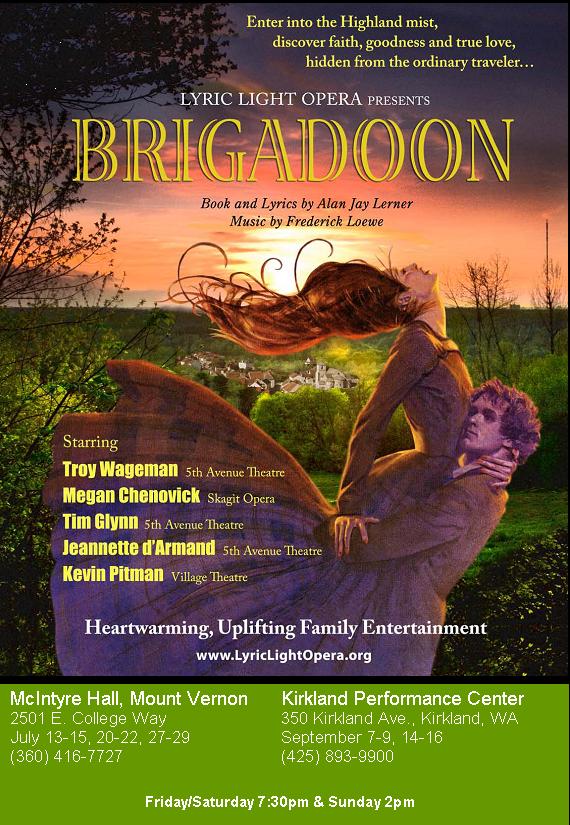
Previously Brigadoon had opened July 13, 2007 for a three week run at McIntyre Hall, Mount Vernon, WA. Click the Brigadoon poster for full size image. July 13-15, 20-22, 27-29 2007 (Fri-Sat-Sun). Conrad Askland will be conducting a fine orchestra for this show – hope you can make it.
FEATURED LEADS:
Troy Wageman (5th Avenue Theater)
Megan Chenovick (Skagit Opera)
Tim Glynn (5th Avenue Theater)
Jeanette D’Armand (5th Avenue Theater)
Kevin Pitman (Village Theater)
Some of the musical terms used in the original orchestra score for Brigadoon.
Mosso – Rapid. Meno mosso, less rapid. Piu mosso, more rapid.
Morendo – gradually dying away
Colla Voce – Follow the voice. A directive to the musican (normally accompanist) to perform the indicated passage in a free manner following the tempo and style of the solo performer.
L’istesso tempo – The same tempo. An indication in a composition that directs that the beat remains constant when the meter changes. In the case of 2/4 to 6/8, the meter is still counted with two beats per measure but the tempo or speed of the beat stays the same. All that has changed is the subdivision of the beat from the duplets of the 2/4 to the triplets of the 6/8.
Tenuto (ten.) – Tenuto can mean either hold the note in question its full length (or longer, with slight rubato) or else play the note slightly louder. In other words, the tenuto mark is sometimes interpreted as an articulation mark and sometimes interpreted as a dynamic mark. When it appears in conjunction with an accent mark, it is of course taken as an indication of articulation, and, conversely, when it appears in conjunction with a staccato mark, it is taken as an indication of a slight dynamic accent. When it appears by itself, its meaning must be determined by its musical context. In rudimental (drumline) drumming, the tenuto marking is traditionally interpreted by giving the marked note a slight accent or emphasis.
Lento – slow
Piu – More. Used with other terms, e.g. piu mosso, more motion.
So the mystery is finally solved about the Piano part in the orchestration for the Brigadoon musical.
I just received my scores. The piano part is “boom-chucks” during the cut time pieces, glissandos into sections and occasional celeste parts. I wouldn’t say it’s an essential part, but definately will add to the rhythm section.
The official Brigadoon orchestration calls for the timpani player to double on snare and brushes – there is no dedicated trap set drum part.
For my orchestra I split the rhythm section up like this:
Percussion – Timpani, snare drum, cymbals
Percussion – Bells (have keyboard player cover bell parts from percussion score)
Piano – Have piano player play the piano part lightly as written.
If you listen to the CD soundtrack of Brigadoon, you’ll hear the piano come in and out, especially on the glissandos. My assumption is this was orchestrated at a time when dedicated rhythm section and trap set drummers weren’t the norm yet in Broadway orchestra pits. If it was orchestrated today I think it would lean towards a regular drum kit, with a couple keyboard players covering bells and accentuating rhythms.
If you’re conducting this show you’re probably using the piano/vocal reduced score – know that the piano part in the orchestration is not a doubling of the reduced piano score – it mainly focuses on rhythm and light chord flourishes.
This is the full orchestration list for Brigadoon performance with orchestra. There is also a stage band orchestration available (but not as cool as using the orchestra).
Our upcoming presentation of Brigadoon uses the full classic orchestration (because we’re just cool like that).
 BRIGADOON ORCHESTRATION
2Â Â Â Â Violin I
1 Â Â Â Violin II
1 Â Â Â Viola
1 Â Â Â Cello
1 Â Â Â Bass
1 Â Â Â Flute – Piccolo
1 Â Â Â Oboe
1 Â Â Â Clarinet I
1 Â Â Â Clarinet II
1 Â Â Â Bassoon
1 Â Â Â Horn
1 Â Â Â Trumpets I & II
1 Â Â Â Trumpet III
1 Â Â Â Trombone
1 Â Â Â Percussion:
* Timpani (2 Drums)
* Snare Drum (Brushes & Sticks)
* Bass Drum
* Field Drum
* Tom Tom
* Cymbals
* Glockenspiel
* Chimes
* Temple Blocks
1 Â Â Â Piano & Celeste (Piano-Conductor’s Score sent with rehearsal material)
What makes an accent real, and what makes it phony? What is really a Southern accent in the United States and what is someone doing a vocal caricature. What is a true cockney accent and what mistakes do Americans typically make with English accents on stage?
I have no idea. But here is a variety of information on accents for you to investigate further. Listen particularly to rhythm, intensity and articulation.
Listen to accents from all over the world to compare spoken word accents. What a great tool for studying speech. These recordings are real people, not stereotypes. A great reference for real world speech accents. On this website, each recording is someone from a different part of the world saying the following paragraph:
Please call Stella. Ask her to bring these things with her from the store: Six spoons of fresh snow peas, five thick slabs of blue cheese, and maybe a snack for her brother Bob. We also need a small plastic snake and a big toy frog for the kids. She can scoop these things into three red bags, and we will go meet her Wednesday at the train station.
Listen in to the diverse voices of the United Kingdom, Channel Islands and Isle of Man – from Shetland to Penzance. Eavesdrop on Rotarians in Pitlochry and Travellers in Belfast. Drop in on skateboarders in Milton Keynes. Overhear pigeon fanciers in Durham.
The clips are drawn from the Voices recordings – which capture 1,200 people in conversation. Some of the clips are people talking about language – slang, dialect, taboo words, accents. Other clips cover all sorts of subjects and simply offer a flavour of how we talk today.
“I think the US has always had a more of an emphasis on mobility which is why there hasn’t been a core of accent speakers to build a distict accent. Regional accents are changing in the UK now and in the south most of the old accents are dying out.”
Ever been baffled by the bard? Vexed by his verse? Or perplexed by his puns? London’s Globe theatre thinks it has the answer: perform Shakespeare’s plays in Shakespeare’s dialect.
The Globe, London (pic Donald Cooper)
The Globe will stage Troilus and Cressida for six weeks
In August the theatre will stage an “original production” of Troilus and Cressida, with the actors performing the lines as closely as possibly to the play’s first performance – in 1604.
By opening night, they will have rehearsed using phonetic scripts for two months and, hopefully, will render the play just as its author intended. They say their accents are somewhere between Australian, Cornish, Irish and Scottish, with a dash of Yorkshire – yet bizarrely, completely intelligible if you happen to come from North Carolina.
For example, the word “voice” is pronounced the same as “vice”, “reason” as “raisin”, “room” as “Rome”, “one” as “own” – breathing new life into Shakespeare’s rhyming and punning.
WHY ARE ACCENTS IN A PARTICULAR PLACE THE WAY THEY ARE?
Why are the accents a particular place like they are?
Separate development accounts for some accent variation. But sometimes we need to talk about the first generation of speakers of a particular language brought up in a new place. The first children to grow up in a new place are very important. The children who grow up together are a ‘peer group’. They want to speak the same as each other to express their group identity. The accent they develop as they go through their childhood will become the basis for the accents of the new place. So where does their accent come from?
The first generation of children will draw on the accents of the adults around them, and will create something new. If people move to a new place in groups (as English speakers did to America, Australia and New Zealand) that group usually brings several different accents with them. The children will draw on the mixture of accents they hear and create their own accent out of what they hear. The modern accents of Australia are more similar to London accents of English than to any other accent from England — this is probably because the founder generation (in the eighteenth century) had a large component drawn from the poor of London, who were transported to Australia as convicts. The accents of New Zealand are similar to Australian accents because a large proportion of the early English-speaking settlers of New Zealand came from Australia.
The mix found in the speech of the settlers of a new place establishes the kind of accent that their children will develop.
I’ve always wondered about accents and why we (North Americans) don’t sound like our British or (Insert country of origin) ancestors? When people moved over here from Europe they would have sounded British or whatever to start with, but obviously today they don’t.There are many different accents within the British Isles, and it’s likely that they have changed over the last centuries. Remember also that not all the ancestors of North Americans came from Europe.
WHY DON’T NORTH AMERICANS SOUND BRITISH?
I’ve always wondered about accents and why we (North Americans) don’t sound like our British or (Insert country of origin) ancestors? When people moved over here from Europe they would have sounded British or whatever to start with, but obviously today they don’t. How long does this process of dialect/losing or gaining accent take? And why does it happen? I suppose it has to do with language evolving and regional influences. It’s odd but people from the South Shore of Nova Scotia sound to me like they could be from Maine…..very similar accent…I love accents.